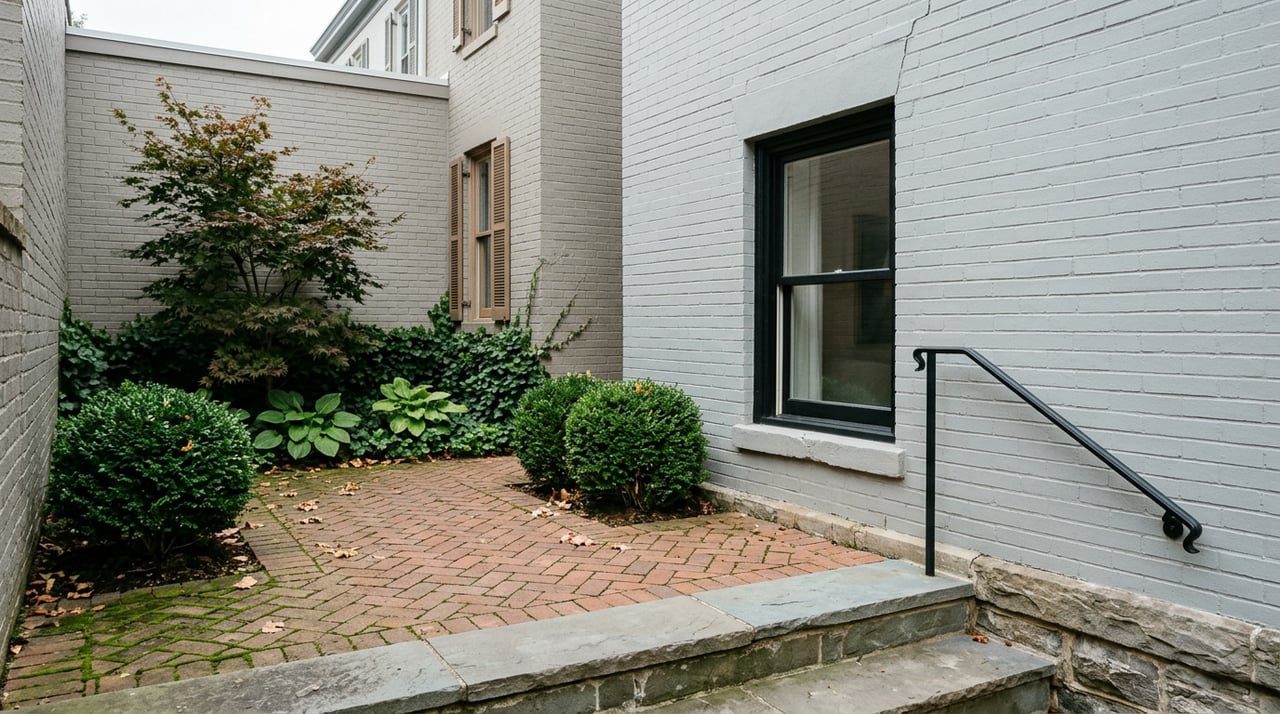
Folger Park's Reopening Keeps Slipping, and the Fence Explains Why No One Can Speed It Up
September 17, 2026
September 17, 2026
On September 3, a Capitol Hill resident walked past Folger Park and watched a crew tearing up asphalt that had been poured only weeks earlier, ripping out paths that were supposed to replace the old crushed stone for good. The reader wrote in to PoPville with a simple question: will the park ever reopen? It is a fair thing to wonder. The fence around that triangular square at 2nd and D Streets SE has been up for so long that plenty of people on the Hill have stopped registering it as temporary.
Here is what makes this worth understanding beyond the frustration of one more missed date. Folger Park is not stuck because a contractor is slow or because the city cannot get its act together. It is stuck because it does not belong to the city at all, and that single fact explains every delay on the list.
Folger Park is one of the larger green spaces on Capitol Hill, a shaded square with paved walkways, benches and mature plantings that has functioned for generations as a everyday gathering spot rather than a destination. It sits alongside Lincoln Park, Stanton Park and Marion Park as part of a cluster the National Park Service groups together as the Capitol Hill Parks, all managed by National Capital Parks East. That detail matters more than it sounds like it should. These are neighborhood parks in every way residents experience them, but they answer to federal park management, not to the District government, the Department of Parks and Recreation, or Ward 6's council office.
The park earned its official name in 1885, honoring Charles J. Folger, a Treasury secretary who died in office the year before. None of that history is on pause. What is on pause is a rehabilitation project meant to repair the historic walkways and plaza, fix and install benches, and restore the plaza's vegetation, a straightforward scope on paper.
The saga is easier to follow as a sequence than as a single frustrating fact:
That is not one delay. It is four, stacked on top of a project that was supposed to take roughly nine months and is now closing in on eighteen.
The most telling detail in the whole story is buried in NPS's own contract language. When asked why the sidewalk work needed to be redone, the agency said plainly that portions of the work did not meet its standards. The contract itself specifies that concrete work failing inspection has to be repaired at no cost to the National Park Service.
That clause protects the agency's budget. It does nothing to protect the calendar. There is no equivalent clause that penalizes a contractor for taking six extra months, and there is no city official who can lean on NPS the way Ward 6's councilmember or the Capitol Hill BID can lean on a DC agency running a similar project. Folger Park's rehabilitation runs entirely inside federal contracting and federal inspection cycles. ANC6B, the neighborhood's own advisory body, has been active around the park this year, but its recent actions tell you exactly where its authority stops: it approved a liquor license amendment for the Folger Shakespeare Library's summer garden, a matter squarely within local jurisdiction. Nobody on that committee has a comparable lever to pull on the park itself, because the park isn't theirs to manage.
That is the piece of this story that doesn't show up in the "reopening delayed again" headlines. The delay isn't a mystery about competence. It's a jurisdiction problem, and it will keep producing missed dates for as long as the work touches federal-standard sidewalks inside a federally managed park.
Life on the block hasn't waited around for the park. The Folger Shakespeare Library's new summer garden license was approved specifically to align with the September 25 opening of Measure for Measure, meaning there will be a licensed outdoor space serving the production's audience at the library's East Capitol and Third Street entrance starting later this month, right across from the still-closed park.
A few blocks away, the Eastern Market Community Advisory Committee holds its regular meeting on Wednesday, September 30, in the North Hall at Eastern Market, where members will elect the seat reserved for an independent community resident. It's a small piece of neighborhood governance, but it's one more example of the kind of local process that does have direct authority over a Capitol Hill institution, in contrast to the process governing Folger Park.
If you live within walking distance of that fence, the practical takeaway isn't to circle October 3 on your calendar. This project has missed a winter 2025 target, then a summer 2026 target, and the asphalt work reported in early September suggests another round of corrections is already underway. The pattern so far has been consistent enough that a fifth date wouldn't be surprising.
The more useful habit is knowing where to look. Capitol Hill Corner and PoPville have both been the first to report each delay, often faster than any official notice posted at the site. If the fence finally comes down, that's likely where you'll read about it first, well before a new sign goes up.
None of this changes what Folger Park has always been for the neighborhood: a shortcut, a place to sit outside for ten minutes, a patch of shade between errands. It'll be that again. The federal calendar just runs on its own clock, and this year that clock has been slow enough to notice.
If you're thinking about what it actually means to live two blocks from a federal park instead of a city one, or you're weighing a move to Capitol Hill and want someone who tracks this kind of neighborhood detail, Live In The Dream would love to talk. Work With Us — Get a Free Home Valuation.
Stay up to date on the latest real estate trends.

marketupdate
Monthly Newsletter
At Live In The Dream, we believe that finding or selling your home should be a seamless and enjoyable experience. Our dedicated team of real estate professionals is committed to providing you with the highest level of service, personalized to meet your unique needs.
Kathy Caputo Worek
Megan Worek
Virginia & DC Office
9990 FAIRFAX BLVD SUITE 160
FAIRFAX VA 22030
North Carolina Office
464 WILLIAMSON RD SUITE A
MOORESVILLE NC 28117